View Photos
 Entire home/flat
  4 Guests
  2 Bedrooms
  2 Beds
  2 Bathrooms
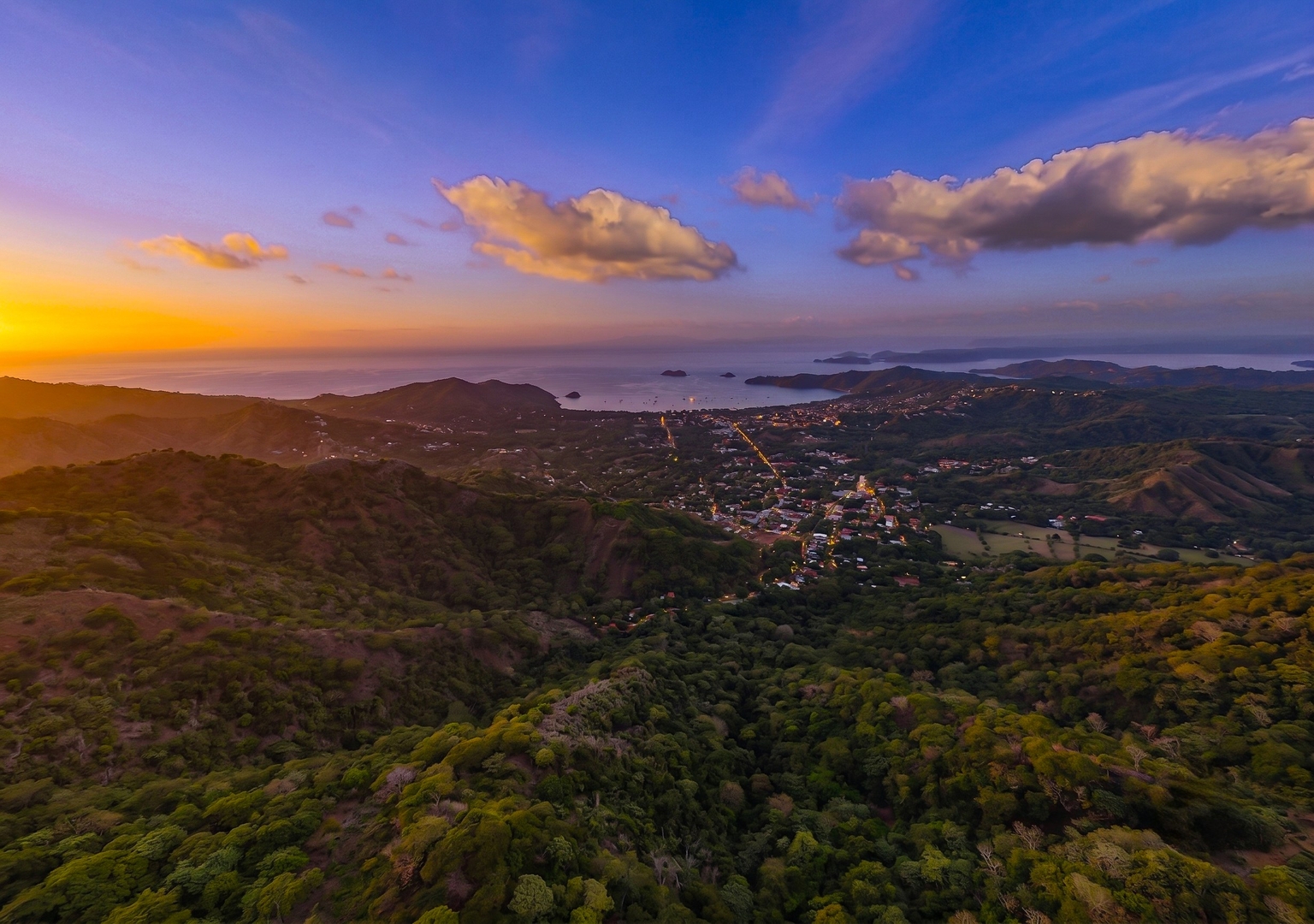
 Wake to howler monkeys, drink coffee on a covered terrace in the trees, and be on the sand by nine. This is a detached villa in a gated forest community above Playas del Coco: two bedrooms, two extraordinary stone-and-hardwood bathrooms, a full kitchen, and arched screened windows that put green in every direction. Pool and shaded rancho on site, one covered parking space, beach five minutes down the hill. Local team, always reachable.
Wake up in the forest. Be on the beach by nine.
The howlers start before the light does. You'll hear them somewhere up the hill, work out they're a long way off, and go back to sleep. An hour later you're on the terrace in yesterday's t-shirt with a coffee, watching a turquoise-browed motmot sit on a wire doing absolutely nothing. Ticos call that one pájaro bobo, the silly bird, because it'll let you walk right up. Then you decide: beach day or volcano day. Either way there's no rush.
This is a house, not a unit
Horizon Lounge is a gated community of about a dozen casitas scattered through the trees on a hillside above Coco, and yours is a standalone one. No shared walls. Nobody upstairs. You step out your own front door onto your own terrace, and the closest thing to a neighbor is whatever's in the branches.
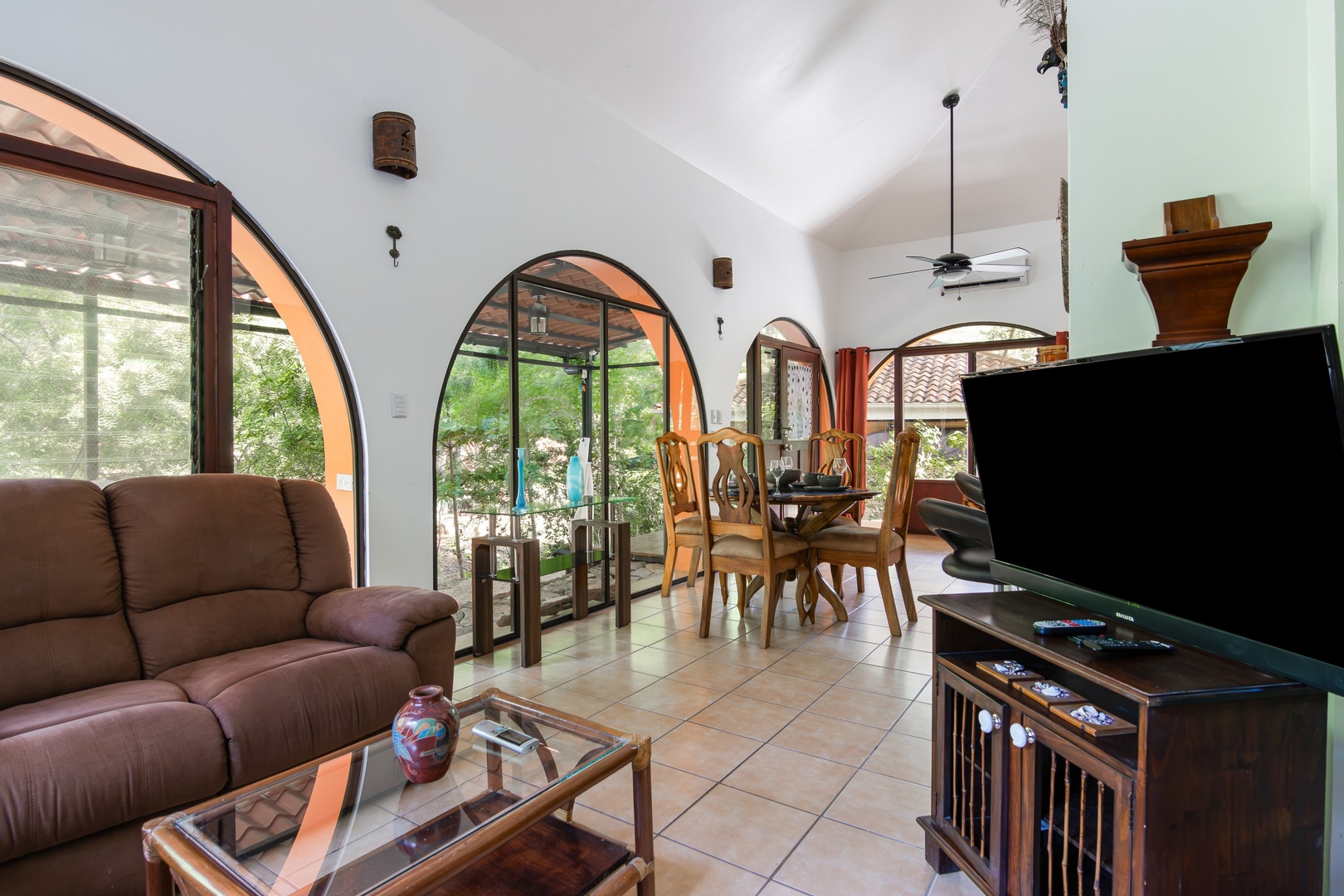
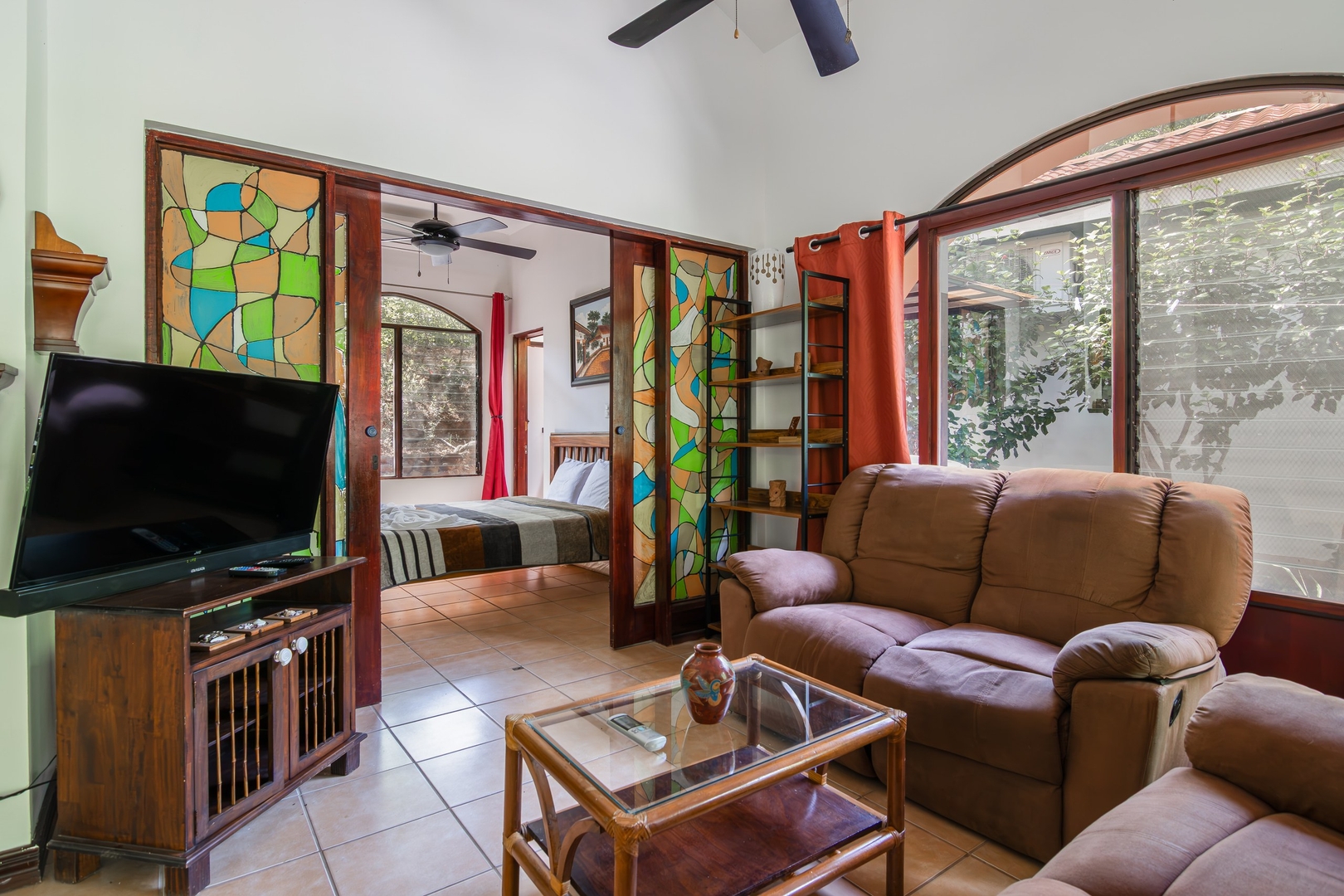
The front door has a peacock worked into hand-painted stained glass. Inside, white vaulted ceilings run the length of the place, terracotta tile underfoot, and tall arched openings on nearly every wall. Four of them line the living room alone. They're screened, so they stay open, which means the breeze moves through all day and you fall asleep to insects and wake up to birds. More stained-glass panels, feathers this time, slide across on dark hardwood tracks to close off the bedrooms when you want them closed. Somebody built this place by hand and it shows.
Ceiling fans in every room. Air conditioning in the living area and both bedrooms, for the March afternoons when you want it.
Then you see the bathrooms
Both are finished floor to ceiling in river rock. The vanities are single slabs of live-edge tropical hardwood, still the shape of the tree. The sinks are river stones, hollowed out. Matte black rain heads, glass walk-in showers, a recessed stone shelf for your things. One opens straight off the main bedroom.
The practical version: after a morning at Ocotal you rinse the salt off standing in something that belongs in a lodge charging four times this. The honest version: guests photograph these more than the pool.
Two real bedrooms, so nobody draws the short straw
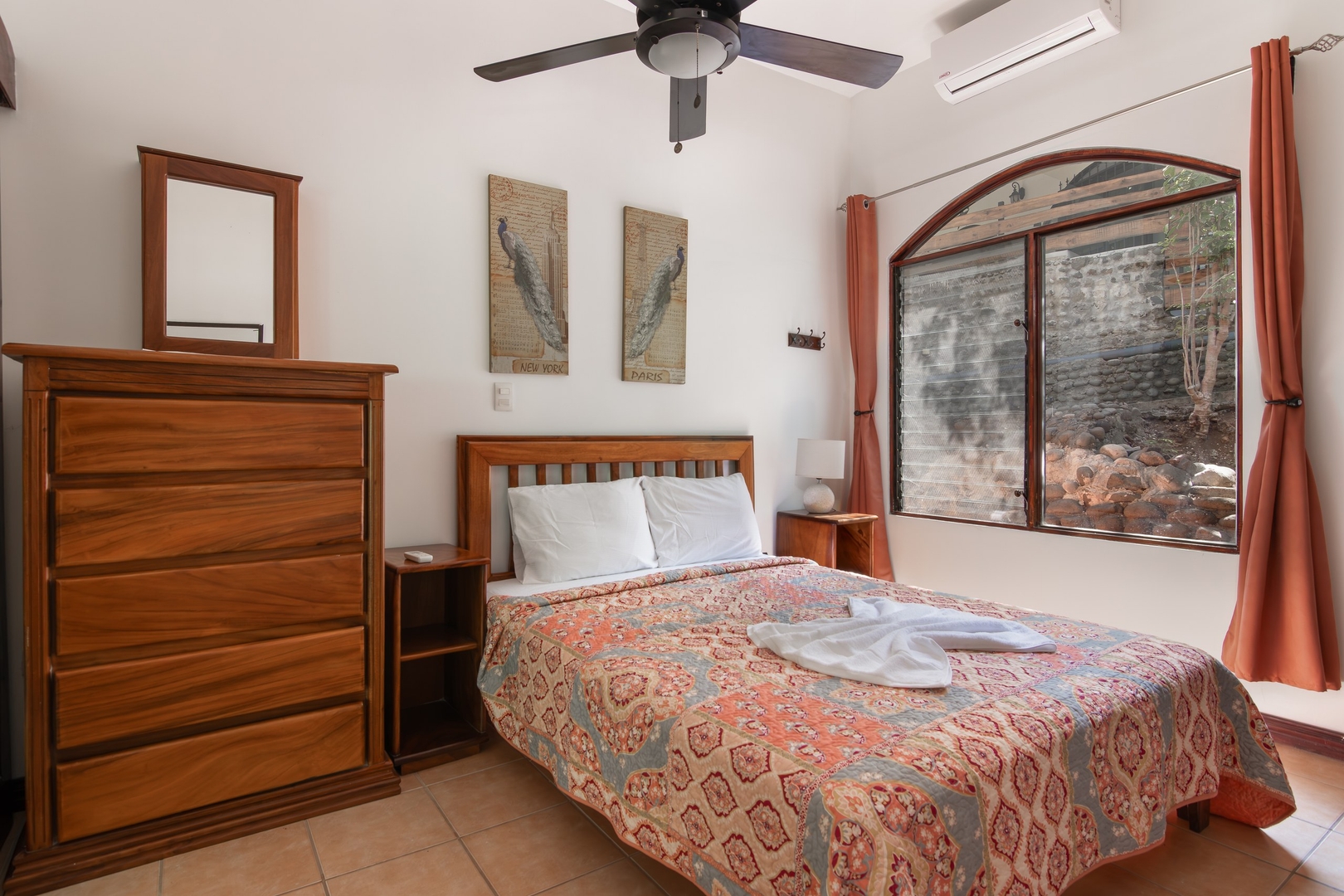
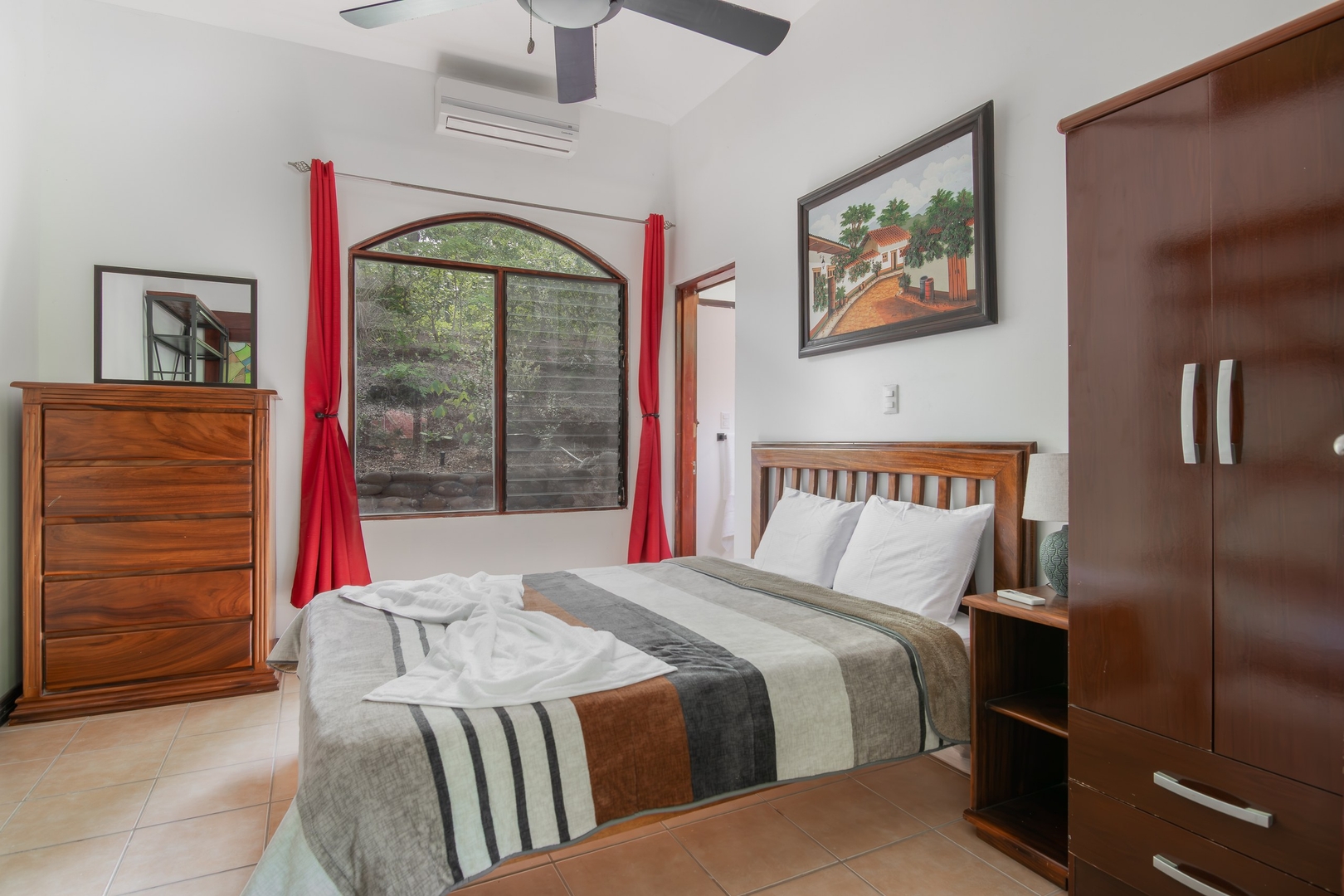
Both have a queen bed, a ceiling fan, air conditioning, a tall hardwood dresser, a wardrobe, and an arched window looking into leaves. Two couples each get a proper room and a proper bathroom. A family of four never queues for a shower. Nobody sleeps on a sofa.
A kitchen worth cooking in
Real tropical hardwood cabinetry, dark granite counters, a stainless fridge and stove, microwave, coffee maker, blender, rice cooker, toaster, and a breakfast bar with two stools for the person who supervises. Full cookware, dishes and cutlery for four, and yes, wine glasses.
This matters more than it sounds. Produce here is cheap and ridiculous, the fish comes off boats you can see from town, and a Wednesday night of grilled dorado and a bottle of something costs less than two entrees out. There's a washer and a dryer in the casita too, so you can pack for four days and stay for two weeks.
The terrace is where you'll actually live ☕
A covered pergola with a clay tile roof wraps the casita. Two ceiling fans, hanging lanterns, a bistro table for four, umbrellas for the edges, a live-edge stump table, and a wide hardwood deck stepping down to white gravel and river-stone borders. Forest on three sides.
Roof means shade in the dry season and dry seats in the green season, so it works in October the same as it works in February. Realistically you'll eat every meal out here, work out here if you have to, and read out here until it's too dark to see.
And when you want company
The community pool is a big free-form one with a wide sun deck, its own restrooms, and flame trees dropping orange all over the edges. Next to it there's a covered rancho with lounge chairs, ceiling fans, and several dining tables, which is where you go when you want shade and other humans. Your covered parking space keeps the car from turning into an oven, and there's a large lot if you bring a second.
The gate stays closed and visitors sign in. Small thing, but it's why people sleep well here.
The forest is the whole point
Guanacaste's tropical dry forest is the rarest major ecosystem in Costa Rica and one of the scarcest in Central America, and Horizon Lounge sits right inside it, with forest on three sides.
Day to day: howler monkeys before dawn, white-throated magpie-jays arguing in the canopy, Hoffmann's woodpeckers working the trunks, and flocks of orange-fronted parakeets tearing through at first light and again at dusk. Bring binoculars. The window between 6 and 8:30 in the morning is the good one, and you can do all of it from the terrace without putting shoes on.
We won't promise you sloths. Guanacaste is too dry for them, and anyone telling you otherwise is selling something. Diamante Eco Park, 30 minutes away, has rescues if the kids need a sloth.
Five minutes down the hill
Playas del Coco: groceries, pharmacy, ATMs, dive shops, and everything from a $6 casado to a long dinner with sand under the table. The bay is wide and the sunsets are dependable.
Playa Ocotal is 15 minutes the other way, with rocky points at both ends and the clearest water nearby for snorkeling. Playa Hermosa and Playa Panamá are 10 to 15 minutes north.
And the big days out
Diamante Eco Adventure Park, 30 minutes, with the largest animal sanctuary in the country and a zipline over the ocean. Llanos de Cortez waterfall, about an hour, swimmable at the base. Rincón de la Vieja volcano and its mud pots and steam vents, roughly an hour and a half, and it stays green in February when the coast has gone gold. The Tempisque River boat safari at Palo Verde, under two hours, for crocodiles and monkeys and serious birds. And boats leave Coco for the Catalina Islands, where giant Pacific mantas pass through from December into April.
Check-in from 3 PM, checkout by 10 AM. Three-night minimum in high season, two nights in low season.
Self check-in with a lockbox, so late flights are fine.
The gate requires visitors to sign in. Let us know in advance if you're expecting anyone.
No parties or events. This is a small residential community with full-time neighbors and sound carries up here.
Quiet hours 10 PM to 7 AM. No smoking indoors.
Please don't feed the monkeys or any other wildlife. It makes them aggressive and sick, and the people who live here year-round deal with the consequences.
Keep the screens shut. They're the only thing between you and the forest.
Pets: ask us.
Self check-in with a lockbox at the casita, so a delayed flight is no drama. We send the code before you travel. The community gate is controlled and all visitors sign in, so let us know in advance if you're expecting anyone.
We're Expat Properties CR, a small team that lives in Coco full time. Not a call center. If the AC sulks, someone comes. If you want to know where the good ceviche is on a Tuesday, ask.
You're living inside a working piece of forest. Expect geckos on the walls, the occasional insect, and monkeys on the roof around sunrise. The screens stay closed for a reason, and they work.
There's no ocean view from the casita. Every window faces trees. We think that's the better trade, but we'd rather you know now than be surprised.
Rural Guanacaste gets the odd brief power flicker. Cell service is good and the WiFi is solid.